8 maj, 2026
Quick Impressions: Yerevan, Armenia
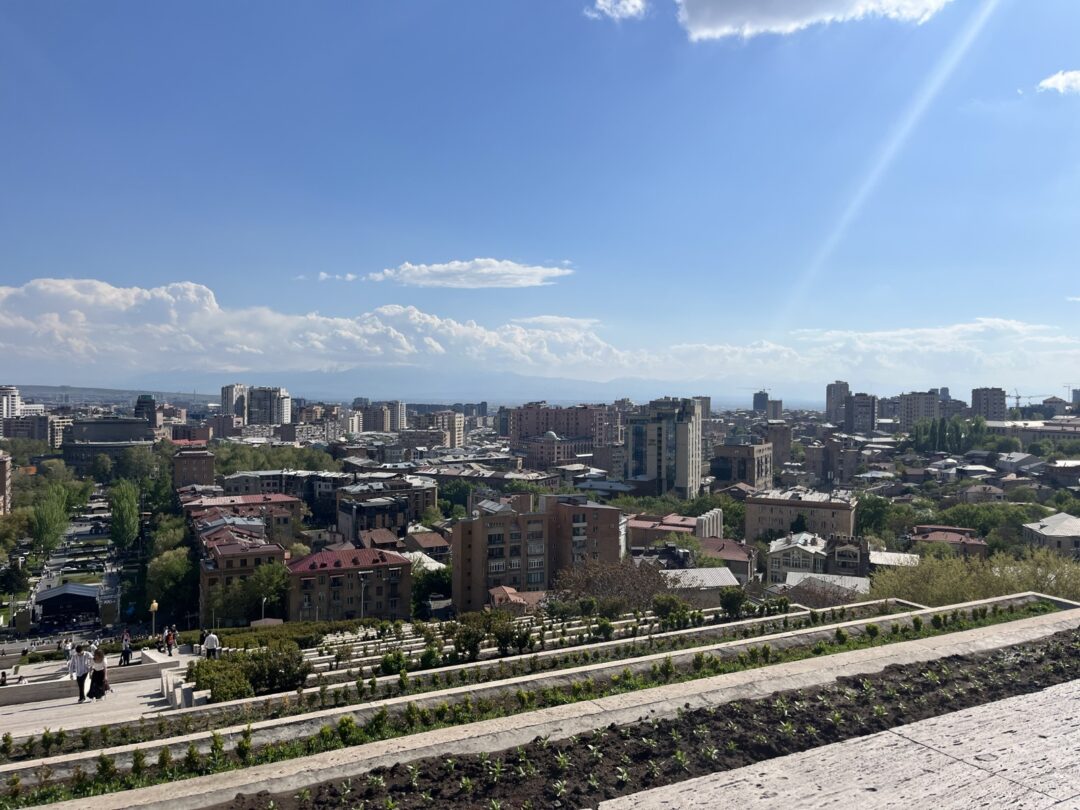
SCEEUS analyst Jakob Hedenskog and centre manager Fanny Wallberg went to Yerevan, Armenia, on 27-30 April to take stock of the upcoming parliamentary elections on 7 June, 2026. Here are their quick impressions.
Armenia is currently in the European spotlight. This week Yerevan hosted both the first ever EU–Armenia summit and a meeting of the European Political Community (EPC), drawing European leaders to the country. The EU recently established a second, separate civilian mission, the EU Partnership Mission in Armenia (EUPM Armenia), announced on 21 April, to strengthen resilience against hybrid threats, including cyber-attacks and disinformation.
At the same time, Armenia is preparing for parliamentary elections on 7 June, and the political environment has become increasingly tense. Government and opposition forces alike have escalated the rhetoric and framing the election as highly decisive for the country’s future, with sharp criticism on both sides.
Geopolitically, Armenia remains in a highly constrained position. Despite rhetorical moves towards the West, including cooperation with the EU and increasing engagement with the United States, the country remains economically and structurally tied to Russia through trade, energy dependence, and significant diaspora linkages. Russia still has a military base in Gyumri and Russian FSB border troops continue to patrol Armenia’s borders to Türkiye and Iran. At the same time, regional dynamics – particularly the potential normalisation of relations with Türkiye and the evolving posture of Azerbaijan – are widely seen as factors that could significantly reshape Armenia’s economic and security outlook.
The election is shaped by several overlapping questions: how to consolidate peace with Azerbaijan, how to define Armenia’s regional identity, how to recalibrate relations with Russia, and how far European integration should proceed. A fifth, increasingly important dimension concerns domestic governance and the broader question of political legitimacy itself.
Prime Minister Nikol Pashinyan and his party, Civil Contract, remain the dominant political force in the election, although his position remains contested. He is seen by supporters as the leader of a pragmatic shift: normalisation of relations with Türkiye, reducing dependence on Russia, and slowly building closer ties with the EU and the US. Critics, however, blame him for military defeat and accuse his government of weakening democratic standards and using state institutions for political purposes.
The opposition, in contrast, remains fragmented and largely centred around individual figures rather than a shared political vision. According to recent polling, the oligarch Samvel Karapetyan’s Strong Armenia is polling around 12%, while Civil Contract remains around 34%. Karapetyan and other more pro-Russian candidates, such as a party led by Armenia’s second president Robert Kocharyan, have focused largely on the consequences of Armenia’s military defeat and Azerbaijan’s recapture of Nagorno-Karabakh 2020-2023, government failures, and claims that the current system is controlled rather than genuinely democratic. There are also smaller opposition groups with a more pro-European orientation, although their electoral support remains limited. Overall, there is little evidence of broad unified support for the opposition as a whole, and polling remains uncertain due to the large number of undecided voters.
A key feature of this election is low political engagement, especially among younger voters. Many are frustrated with politics in general and do not strongly identify with either side. There is also a broader decline in trust in public institutions, not just political parties. At the same time, many Armenians continue to express support for closer ties with Europe, even if this does not always translate into voting behaviour.
The election result will likely indicate Armenia’s broader future political direction, but much about the country’s future trajectory remains uncertain. Stay tuned for SCCEUS reporting on Armenia’s relationship with the EU and analysis of the election results in coming months.
