
1 October, 2026
Quick impressions: APRI forum Yerevan, Armenia
By Jakob Hedenskog
APRI Forum is a conference organised by the independent think tank Applied Policy Research Institute of Armenia (APRI Armenia). Its purpose is to serve as a strategic meeting place for policymakers, diplomats, academics, and civil society leaders to discuss geopolitical stability, regional security, and economic development. Since 2022, the APRI Forum has brought together participants not only from the South Caucasus region but from a rather vast spectrum of countries, even some involved in conflicts in and around the region – such as Russia, European countries, the United States, as well as Iran. Participants from Azerbaijan and Türkiye were not physically present but joined via video link.
These quick impressions give some reflections from the discussion at the APRI Forum 22 to 25 September 2026 on three central themes: the Armenia-Azerbaijan peace process, the Armenia-EU relations and the policy of Iran in the South Caucasus region.
First, discussions on the on-going peace process between Armenia and Azerbaijan revealed some different opinions between Yerevan and Baku. On the one hand, some Azerbaijani participants pointed on the achievements that have been made in the process, such as the agreed but not signed peace agreement and the advanced discussions on unblocking regional transport and economic links. On the other hand, some Armenians called for the breaking of what they perceived as a “vicious circle” where Azerbaijan is not signing the peace agreement, using the pretext of constitutional change in Armenia, and simultaneously stops Armenia-Türkiye normalization, using the absence of Armenia-Azerbaijan peace agreement. According to this opinion, nothing what has been achieved, so far, in the peace process is irreversible, all can be changed by a decree from Azerbaijan’s President Aliyev. Azerbaijan can claim new preconditions for signing the peace agreements also after the eventual changing of the Armenian Constitution.
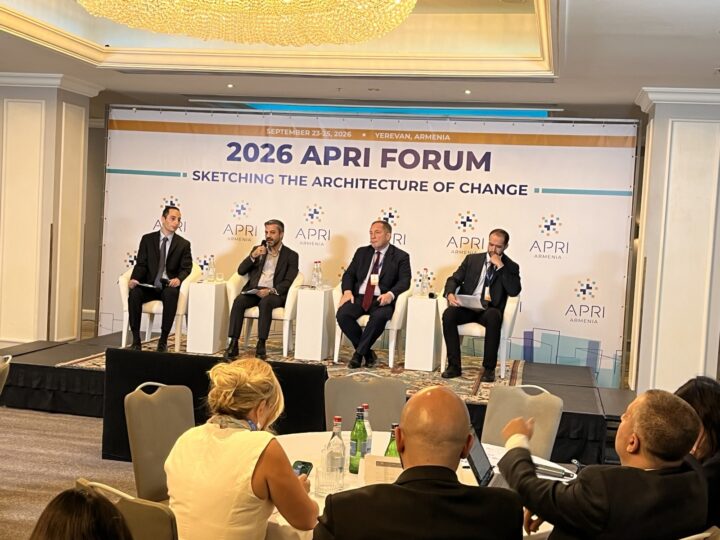
Photo: SCEEUS
Second, as for the Armenia-EU relations, the current positive security dialogue between Yerevan and Brussels was noted, encompassing discussions on visa-free travel, summits, and the new EU Partnership Mission (EUPM) in Yerevan.
However, the focus is on diversification, not on “turning to West” or on EU membership per se. While the EU cannot guarantee Armenia’s security, it can enhance its resilience. In this sense, Armenia also offers something equally valuable to the EU: the opportunity to help Armenia become more resilient without requiring new alliances. EU influence can grow by offering a wider range of options, short of membership.
That said, it was also acknowledged that a candidate status and an enlargement process itself acts as an incentive for reform. With a genuinely sustainable and irreversible democratic system, Armenia would have a strong case to present. Future enlargement should proceed gradually – avoiding sudden shocks – and be handled on a case-by-case, country-by-country basis. The underlying philosophy is shifting; enlargement entails a transformation not only of the candidate countries but also of the EU itself, a process that will take time.
Third, it was noted that the policies of the Islamic Republic of Iran in the South Caucasus region have been intensified for some years. Tehran is pursuing a set of policies in response to three connected threats that emerged after the Second Karabakh War in 2020, followed by Russia’s full-scale invasion against Ukraine in 2022, that unsettled a decades old regional order dominated by Russia. The first threat are the perceived aspirations by Azerbaijan to territorial expansionism in the region. The second threat is the foreign presence in the neighbours of Iran, such as the EU in Armenia and Azerbaijan’s military cooperation with Israel, as well as the growing role of the US in both countries, following Yerevan’s and Baku’s endorsements of the Trump Road for Peace and Prosperity (TRIPP), which is perceived as directly hostile to Iran. The third threat is the potential for geoeconomic isolation of Iran, following the eventual Armenia-Türkiye border opening. The Iranian panelists at the Forum identified Iran’s main goal in the region as establishing a new balance of power, without the interference of outside powers, that restores the status quo.
